

Accessibility Tools

Hip

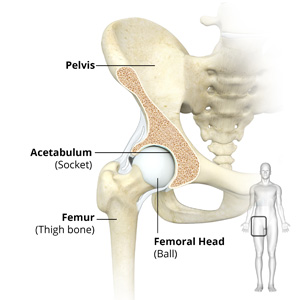
Hip Anatomy - Educational Picture

The hip joint is the largest weight-bearing joint in the human body. It is also referred to as a ball and socket joint and is surrounded by muscles, ligaments, and tendons. The thigh bone or femur and the pelvis join to form the hip joint.

Learn More About Hip Anatomy ›


Hip Conditions & Procedures
Total Hip Replacement Educational Picture

Total Hip Replacement

Total hip replacement is a surgical procedure in which the damaged cartilage and bone are removed from the hip joint and replaced with artificial components. The main indication for total hip replacement is arthritis.

View More ›
Anterior Hip Replacement - Educational Picture

Anterior Hip Replacement

Direct anterior hip replacement, also called direct anterior total hip arthroplasty, is a minimally invasive hip surgery to replace the hip joint without cutting through any muscles or tendons as against traditional hip replacement that involves cutting major muscles to access the hip joint.

View More ›
Revision Hip Replacement - Educational Picture

Revision Hip Replacement

During total hip replacement, the damaged cartilage and bone are removed from the hip joint and replaced with artificial components. At times, hip replacement implants can wear out for various reasons

View More ›
Core Decompression for Avascular Necrosis of the Hip - Educational Picture

Core Decompression for Avascular Necrosis of the Hip

The hip joint is a ball and socket joint, where the head of the thighbone (femur) articulates with the cavity (acetabulum) of the pelvic bone.

View More ›
Hip Fracture Surgery - Educational Picture

Hip Fracture Surgery

A hip fracture can cause sudden pain, difficulty standing or walking, and significant loss of mobility. Prompt evaluation and appropriate treatment are important to help address the fracture and support recovery.

View More ›
Hip Bursectomy - Educational Picture

Hip Bursectomy

The hip joint is one of the body's largest weight-bearing joints and is the point where the thigh bone (femur) and the pelvis (acetabulum) join. It is a ball and socket joint in which the head of the femur is the ball and the pelvic acetabulum forms the socket.

View More ›
Nonsurgical Hip Treatments - Educational Picture

Nonsurgical Hip Treatments

Hip pain can make walking, exercising, working, and performing everyday activities difficult. Conditions such as hip arthritis, overuse injuries, sports injuries, and other musculoskeletal problems.

View More ›
Physical Therapy for Hip - Educational Picture

Physical Therapy for Hip

Physical therapy is an exercise program that helps you to improve movement, relieve pain, encourage blood flow for faster healing, and restore your physical function and fitness level. The main aim of physical therapy is to make your daily activities, such as walking, getting in and out of bed and climbing stairs, easier.

View More ›
Intra-articular Hip Injections - Educational Picture

Intra-articular Hip Injections

"Intra-articular" means "inside the joint." An intra-articular hip injection delivers medication directly into the hip joint, the ball-and-socket joint where the head of the thigh bone (femur) fits into the socket of the pelvis (acetabulum).

View More ›
Osteoarthritis of the Hip - Educational Picture

Osteoarthritis of the Hip

Osteoarthritis, also called degenerative joint disease, is the most common form of arthritis. It occurs most often in the elderly. This disease affects the tissue covering the ends of bones in a joint called cartilage.

View More ›
Inflammatory Arthritis of the Hip - Educational Picture

Inflammatory Arthritis of the Hip

The inflammation of the joints is referred to as arthritis. Inflammation arises when the smooth lining called cartilage at the ends of bones wears away. In some cases, the inflammation is caused when the lining of the joint becomes inflamed as part of an underlying systemic disease. These conditions are referred to as inflammatory arthritis.

View More ›
Hip Fracture - Educational Picture

Hip Fracture

The hip joint is a “ball and socket” joint. The “ball” is the head of the femur or thighbone, and the “socket” is the cup-shaped acetabulum. The joint surface is covered by a smooth articular surface that allows pain-free movement in the joint. 

View More ›
Hip Bursitis - Educational Picture

Hip Tendonitis

Tendons are strong connective tissue structures that connect muscle to bone. Hip tendonitis is a condition associated with degeneration of the hip tendons. This condition is mainly caused due to strain on the tendons which may occur due to overuse or biomechanical problems.

View More ›
Hip Bursitis	 - Educational Picture

Hip Bursitis

Hip bursitis is a painful condition caused by the inflammation of a bursa in the hip. Bursae are fluid-filled sacs present in the joints between bone and soft tissue to reduce friction and provide cushioning during movement.

View More ›
Hip Injury - Educational Picture

Hip Injury

The hip joint is one of the most important and flexible joints in the human body which allows us to walk, run, bend and perform physical activities. It is a ball (femoral head) and socket joint formed between the hip bone and femur (thighbone).

View More ›
Hip Pain - Educational Picture

Hip Pain

Hip pain, one of the common complaints, may not always be felt precisely over the hip joint rather in and around the hip joint. The cause for pain is multifactorial and the exact position of your hip pain suggests the probable cause or underlying condition causing it.

View More ›
Hip Labral Tear - Educational Picture

Hip Labral Tear

A hip labral tear is an injury to the labrum, the cartilage that surrounds the outside rim of your hip joint socket.

View More ›
Hip Ligament Injuries - Educational Picture

Hip Ligament Injuries

Injuries to the hip ligaments are commonly called a hip sprain and can range from minor tears of the ligaments to more serious injuries involving the hip muscles, tendons or bone.

View More ›
Stress Fractures of the Hip - Educational Picture

Stress Fractures of the Hip

Stress fractures of the hip are a break in the upper part of the thigh bone (femur) that fits into the socket of the hip joint. It can occur in any part of the hip, however, it mostly occurs just below the ball of the ball-and-socket hip joint called the femoral neck.

View More ›
Acetabular Fracture - Educational Picture

Acetabular Fracture

An acetabular fracture is a break in the acetabulum (ball-and-socket portion) of the hip joint. It usually occurs during high-energy injuries.

View More ›
Femoral Neck Fracture - Educational Picture

Femoral Neck Fracture

The hip is a ball-and-socket joint made up of the head of the thigh bone or femur that acts as the ball and fits into the rounded socket of the hip bone or acetabulum. The neck of the femur is the region just below the ball of the hip joint.

View More ›
Gluteus Tendon Tear - Educational Picture

Gluteus Tendon Tear

The gluteal muscles (situated in the buttocks) are necessary for the stability and movement of the hip joints. The tendons of two gluteal muscles (gluteus medius and gluteal minimus) are attached at the outer hip region and are often called the “rotator cuff of the hip.”

View More ›
Femoroacetabular Impingement	 - Educational Picture

Femoroacetabular Impingement

Femoroacetabular impingement (FAI) is a condition characterized by excessive friction in the hip joint from the presence of bony irregularities. These cause pain and decreased range of hip motion.

View More ›
Hip Dislocation - Educational Picture

Hip Dislocation

The hip joint is a “ball and socket” joint. The “ball” is the head of the femur or thighbone, and the “socket” is the cup-shaped acetabulum. The joint is surrounded by muscles, ligaments, and tendons that support and hold the bones of the joint in place.

View More ›
Gluteus Medius Tear - Educational Picture

Gluteus Medius Tear

A gluteus medius tear is the partial or complete rupture of the gluteus medius muscle due to severe muscle strain. Gluteus medius tears often occur at the tendinous attachment to the greater trochanter of the femur bone.

View More ›
Hip Instability - Educational Picture

Hip Instability

Injury or damage to these structures can lead to a condition called hip instability when the joint becomes unstable.

View More ›
Irritable Hip	 - Educational Picture

Irritable Hip

Irritable hip, also known as acute transient synovitis, is a common disorder of childhood characterized by hip pain and limping. The term transient means that it does not last long. It usually occurs before puberty and affects only one hip. Boys aged between 4 to 10 years are most often affected.

View More ›
Colorado Springs location
4110 Briargate Parkway, Suite 300
Colorado Springs, CO 80920
Get Directions
Colorado Springs location
1655 Quail Lake Loop
Colorado Springs, CO 80906
Get Directions
Monday — Thursday: 7:00 A.M — 5:00 P.M
Friday: 7:00 A.M — 4:00 P.M